

1. General Guidelines
Language and Spelling: Use American English spelling consistently throughout your manuscript. A notable distinction between British and American English is the preference for “-ize” over “-ise” as a suffix.
Quotations:
- Use double quotation marks for quotes, except when part of a quote includes another quote, in which case single quotation marks should be employed.
- Long quotations should be formatted as indented paragraphs without quotation marks.
- Use curly quotation marks (“ ”) instead of straight quotes (").
- If punctuation marks are present alongside quoted material, ensure that the punctuation is placed inside the quotation marks. For example, it should be “‘Less is more.’” rather than “‘Less is more’.” The same applies to commas.
2. Formatting
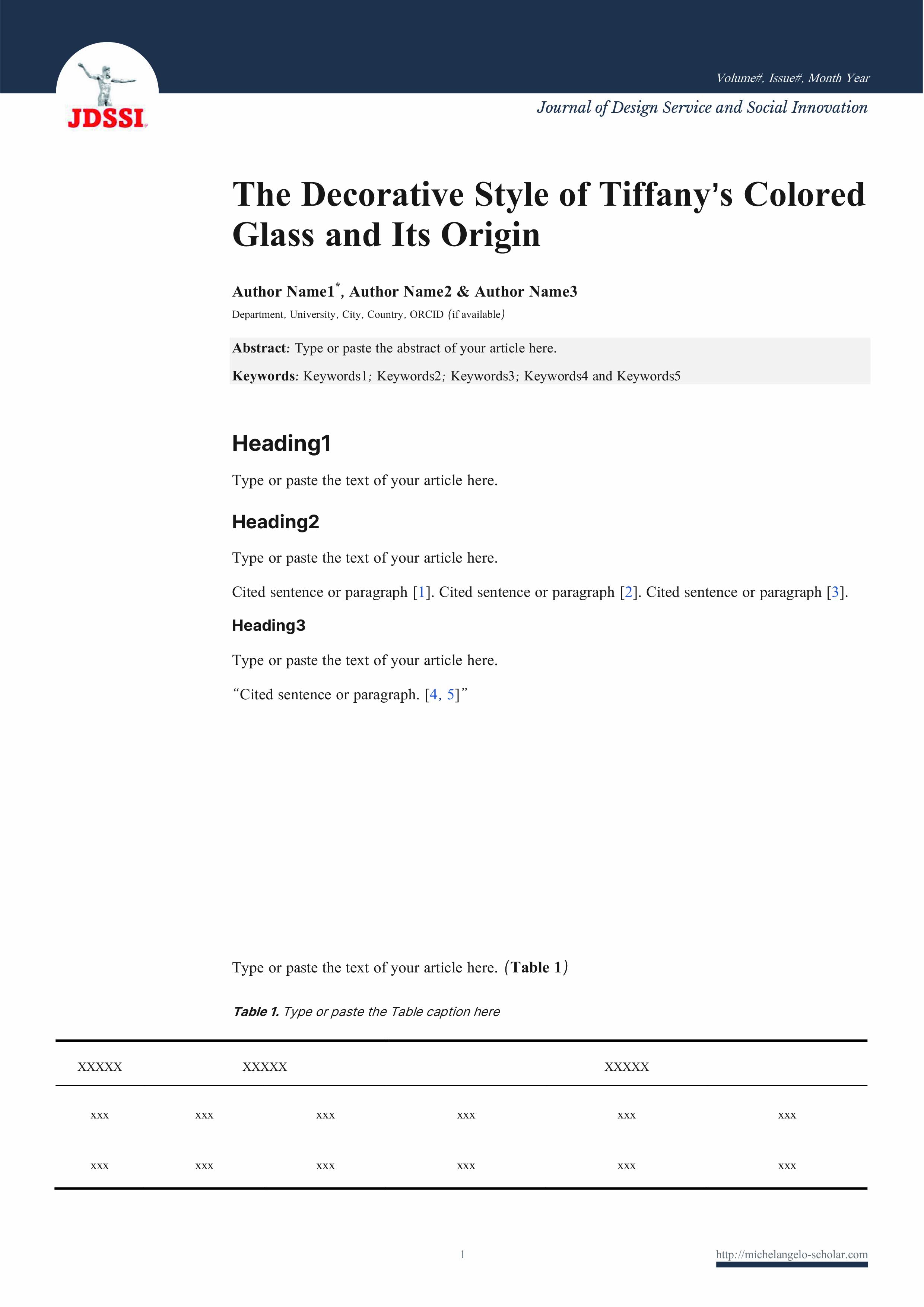
File Format: Manuscripts must be submitted in Microsoft Word format.
3. Author Information
3.1. Author Names
Format:
- Author names should be fully spelled out (surname followed by given name), with the format being “Firstname Lastname” (e.g., “John Smith”).
- Middle names can be abbreviated with a period following the initial (e.g., “John A. Smith”).
- Ensure normal spacing is present between initials (e.g., “John A. C. Smith”).
Consistency: The naming format should be consistent throughout the manuscript, especially for authors from the same country. For instance, Chinese authors can be listed as either “Minghui Jia” or “Ming-hui Jia.”
3.2. Affiliations:
- The affiliation must clearly identify the institution where the work was conducted, formatted as “Institution, City, Country.”
- If the address includes a university, it typically should also mention the department/school/faculty/campus, in the order from specific to general (e.g., “Department, University”).
3.3. Corresponding Author
Please clearly designate the name of the corresponding author and provide their email address.
3.4. ORCID ID
If any authors have an ORCID account, please provide the corresponding account link.
4. Abstract
The abstract should summarize the entire manuscript in a single paragraph, limited to 300 words. It may not contain images, tables, or separate headings, and should avoid continuous headings, website links, equations, or any graphic elements that require separation from the text.
5. Titles and Headings
You may use up to three levels of headings/subtitles. Chapter titles are numbered, with the first-level title denoted as 1.; the second-level title as 1.2.; and the third-level title as 1.2.3. Lower-level headings can utilize letters (A, B, C).
6. Abbreviations
Most acronyms should be spelled out fully on first use, with the abbreviation provided in parentheses. Each section (abstract, main text, figures/tables) handles abbreviations separately, meaning you might need to define the same abbreviation in each section.
Acceptable Latin abbreviations include:
- etc. (et cetera), indicating that the list is incomplete;
- i.e. (id est), meaning “that is,” for clarification;
- e.g. (exempli gratia), meaning “for example,” to introduce examples.
- Note that it is unnecessary to use “e.g.” and “etc.” in the same list. There is common confusion between “i.e.” and “e.g.” — use “i.e.” if your example list is complete, otherwise use “e.g.”. Both “e.g.” and “i.e.” should be followed by a comma and should not be italicized.
7. Punctuation
Periods: A space should follow the period at the end of sentences. Most abbreviations use a period to indicate omitted letters (excluding minor words such as “and,” “or,” and “but”).
Dashes: There are four types of dashes in written form:
- Hyphen (-): Connects two independent words into one concept.
- En dash (–): Medium-sized dash which indicates a connection or range between two concepts.
- Em dash (—): Used to introduce phrases or sections for clarification.
- Minus sign (−): Used in equations or to represent negative numbers.
8. Figures and Tables
Any graphs, supplementary information, etc., must be cited in the body of the text. For example:
- “The data are shown in Table 1.”
- “This case is depicted in Figure 2.”
- Alternatively, you can add the figure or table reference after the sentence, such as “The design of the UI primarily uses bright colors (Figure 5).”
Do not abbreviate tables and figures as “Tab.” or “Fig.” Referenced objects should appear after the citation at the end of the paragraph.
Figure names and table names should be concise and follow title case (capitalizing the first letter of each major word).
Source of Figures and Tables
If the figures or tables are created by the authors themselves, acknowledge this clearly in the figure or table caption: “Drawn by Author Names.”
If not, please obtain copyright permission from the original authors and refer to the guidelines below. Copyright permission is typically obtained via online forms or emails to the copyright holder. The author is responsible for securing necessary permissions.
Reprints: “Reprinted with permission from Author Names (Year of Publication). Copyright Year Copyright Owner’s Name.”
Adaptation: If you adapt or only use parts of charts, permissions are still required, with attribution similar to reprints but using “Adapted” instead: “Adapted from Author Names (Year of Publication).”
Figure Size: Supply figure files in the highest resolution possible. Avoid large file sizes and ensure no unnecessary elements remain, including excess space around the figures. Ensure that figure files do not contain layers or transparent objects.
Preferred Formats: For compatibility with our peer review systems, submit electronic artwork files in JPEG formats:
Recommended Figure Resolutions:
- 300 dpi (Color photographic figures)
- 600 dpi (Grayscale photographic figures, combination figures, photographs, and labeling)
- 1200 dpi (Line art or monochrome figures)
Captions: Do not include captions or figure titles with your image files. Provide these separately as part of the complete manuscript text, ensuring they are numbered correspondingly. Captions should be brief yet descriptive and include any necessary credit lines or acknowledgments for images used with permission. If the image belongs to the author, this should also be acknowledged in the caption.
File Naming Conventions
Name artwork files as Figure 1, 2, 3, etc., in the order they appear in the text. For multi-part figures, label each part accordingly (e.g., Figure 1(a), Figure 1(b)).
Tables: Lengthy lists of categorical data may be added as tables. Each table must have a title located above it.
9. Statements
Include sections for “Author Contributions” and “Conflict of Interest,” which are mandatory.
If there are no specific details to provide for “Funding” and “Acknowledgments,” please indicate “Not Applicable.”
Author Biographies: Provide brief biographies for each author, limited to 100 words, outlining their research interests. Ensure that these biographies include relevant details that connect their backgrounds to the study.
10. References
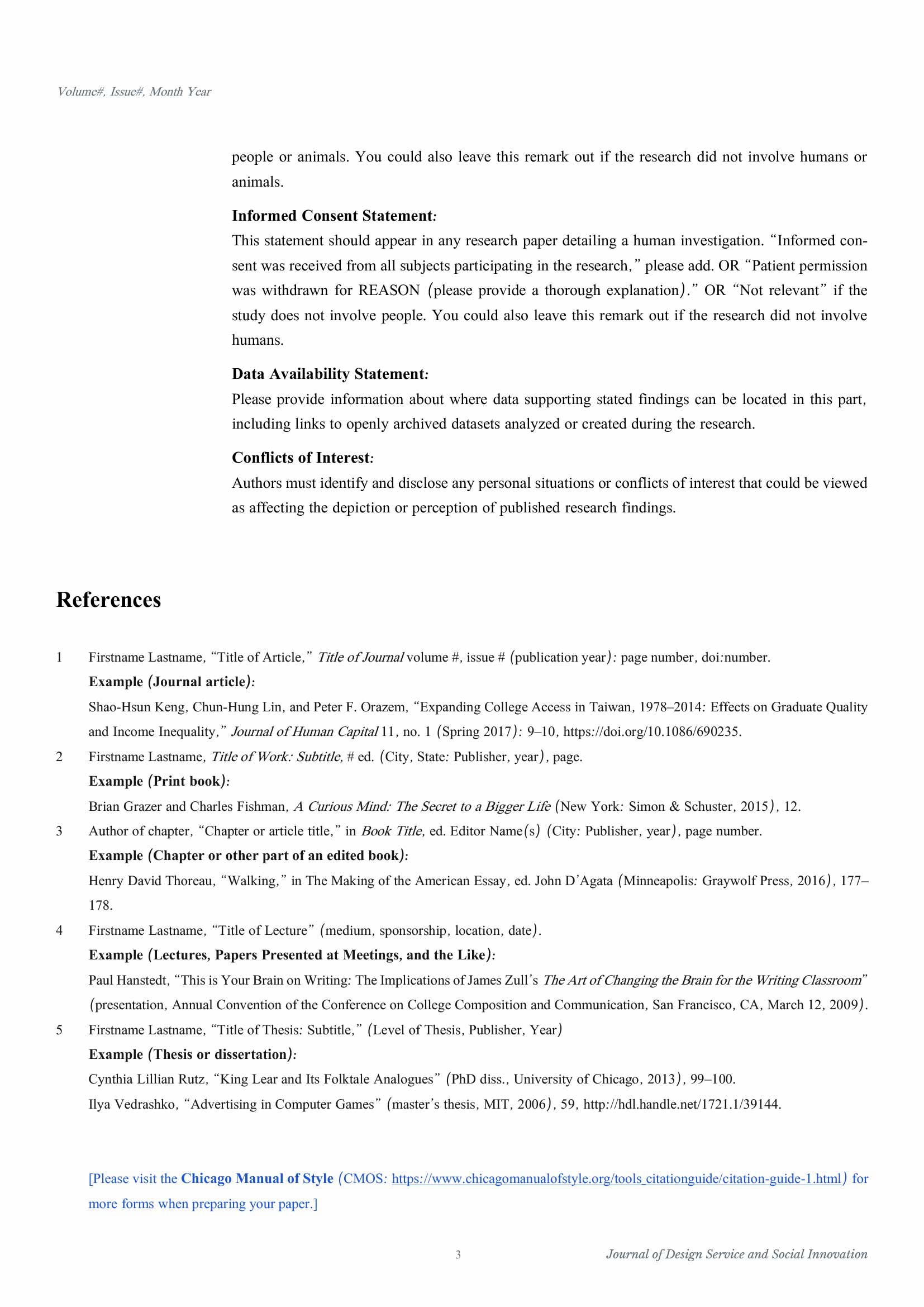
- Use the Chicago Manual of Style (CMOS) for bibliography entries when preparing your reference list. Please note to use the Bibliography entry as the reference format.
- Research articles should include no less than 20 references, while review articles should have at least 30 references.
Submission Reference Verification Policy
The journal implements a strict Reference Authenticity Verification Policy to ensure that all cited sources are genuine, verifiable, and traceable. Accurate and reliable references are essential for the integrity of scholarly communication, allowing readers, reviewers, and editors to locate the original sources, verify claims, and assess the context and credibility of the research. To uphold academic standards and prevent the submission of fabricated, misrepresented, or unverifiable references, the journal requires authors to provide a complete and properly formatted reference list. Adherence to standardized citation practices also facilitates efficient editorial checks, improves review quality, and helps maintain the overall reliability of the scientific record.
10.1. General Requirements
• All references must be genuine and verifiable sources, and authors must be able to provide the original text or an official, traceable source page when required.
• References should be numbered according to the order in which they first appear in the manuscript, with in-text citations following this sequence, and the final reference list arranged in the same numerical order.
• Authors must submit their complete reference list in accordance with the Chicago Manual of Style (CMOS).
• Any online link must be fully functional at the time of submission and include a
• For non-English sources, authors must indicate the original language of the work in the reference list.
• References that fail to meet Chicago formatting requirements or cannot be authenticated will result in the manuscript being returned for revision.
10.2. Journal and Conference Papers
• Publications that have been formally published and assigned a DOI must include the complete DOI link beginning with “https://doi.org/”.
• For papers without a DOI or not yet formally published, authors must provide an official, accessible source page such as the journal website, conference proceedings database, arXiv, SSRN, or a university/ institutional repository. Personal cloud storage, commercial download sites, and unofficial mirror pages are not permitted.
10.3. Webpages, Reports, and News Sources
• All webpage-based citations must include a complete URL that links directly to the original content. Shortened URLs, homepage links, or any page where the cited content cannot be verified are not acceptable.
• Such sources must be accessible at submission, and the citation must include a precise Accessed Date (e.g., “Accessed December 5, 2025”).
• Broken links, unverifiable pages, or use of unauthorized reposts will be considered non-compliant citations.
10.4. Books
• Books do not require URLs, but all available publication details must be provided following Chicago style, including author name(s), book title, city of publication, publisher, year of publication, edition (if not the first), and the specific page range referenced.
• Missing publication details, absent page numbers, non-Chicago formatting, or citations that cannot be matched to the original text will be considered non-compliant and returned for correction.
10.5. Random Checks & 48-Hour Verification
• The editorial office may conduct random checks of 3–5 references at any stage of review or production. Authors must provide the corresponding original materials within 48 hours, including PDFs of journal and conference articles (watermarks allowed), scanned copies of book covers, copyright pages, and cited pages, or PDF/screenshot archives of webpages.
• If a link cannot be opened, the original text cannot be provided, the citation does not match the source, or the reference involves a fabricated DOI, nonexistent source, or any other integrity issue, the verification will be considered failed, and the manuscript may be rejected immediately.
10.6. FAQ (Frequently Asked Questions)
Q1. Why must references follow the Chicago Manual of Style?
Chicago Manual of Style (CMOS) is one of the most widely used and stable academic citation standards. It ensures consistent formatting, allows the editorial team to accurately verify sources, editions, and page numbers, and significantly reduces citation errors. Using a unified format improves review efficiency and helps prevent unnecessary revision or rejection due to formatting issues.
Q2. Can Google Scholar links be used as reference links?
Yes, but only as supplementary links. Authors must still provide the authoritative source, such as a valid DOI or the publisher’s official webpage. Google Scholar is not a formal publishing source, its indexing paths change over time, and it often points to mirrored or unofficial copies. Scholar links may assist in locating a source, but all verification is based on DOIs or publisher-provided pages.
Q3. What if a book has no page numbers?
Authors should provide specific page numbers whenever possible. If an ebook or special edition truly lacks pagination, authors must instead cite chapters, sections, paragraph numbers, or other traceable locators and indicate in the text that the referenced edition has no page numbers. For example: “The cited edition provides no page numbers; citation follows chapter/section identifiers.” Missing both page numbers and alternative locators will be treated as an unclear citation and returned for correction.
Q4. What if a cited webpage becomes inaccessible after submission?
The link must work at the time of submission. If it becomes inaccessible later, authors must supply verifiable evidence during the random check, such as submission-day screenshots, PDF archives, or a traceable archived version. If no verifiable materials can be provided, the citation may be deemed insufficient or unreliable.
Q5. May uploaded PDFs or scanned pages contain watermarks?
Yes. Watermarks do not affect authenticity verification. PDFs of articles, scanned book pages, or webpage archives may include watermarks such as “For review verification only” as long as the content remains clear and readable.
Q6. Why must authors respond within 48 hours during verification?
A 48-hour window is a standard academic integrity practice. It ensures that authors legitimately possess the cited materials rather than relying on last-minute searches. Prompt responses reduce processing delays, prevent long-pending manuscripts from consuming editorial resources, and effectively detect fabricated references, false DOIs, or missing originals.
Q7. What should authors note when citing non-English sources?
For any non-English reference, authors must indicate the language of the original work in the reference list, such as “[in Chinese]” or “[in German]”. This helps editors and reviewers assess the linguistic context of the source. Missing language labels for non-English references will be treated as incomplete citations and may require revision during technical checks.
Instructions for authors
Email: mspl@michelangelo-scholar.com
Tel: +852-66761250
WHATSAPP:+60 11-2370 2845
Room A, 3/F, Wing Tat Commercial Building, 121–125 Wing Lok Street, Sheung Wan, Hong Kong, China



JDSSI
MSPL
JACAC
DH
JAUD